
QOps 3.1.0 installs on Windows 10 and Windows 11, on macOS (Apple silicon) and on Linux. Every installer includes the QOps Portal. Check the prerequisites first.
The download links always point to the newest release.
Windows
There are two installers. Both install QOps for Windows PowerShell 5.1 and for PowerShell 7, with the Portal. Pick one by who will use QOps on the machine.
QOps-setup.msi: all users. For a shared server or a build runner. Needs administrator rights.
- PowerShell 5.1:
C:\Windows\System32\WindowsPowerShell\v1.0\Modules\QOpsModule - PowerShell 7:
C:\Program Files\PowerShell\Modules\QOpsModule
QOpsModule.msi: just for you. For your own computer. No administrator rights needed.
- PowerShell 5.1:
Documents\WindowsPowerShell\Modules\QOpsModule - PowerShell 7:
Documents\PowerShell\Modules\QOpsModule
QOpsModule.msi shows both folders during setup. QOps-setup.msi shows only the PowerShell 5.1 folder, but installs the PowerShell 7 copy at the same time, in the folder listed above. The v1.0 in the Windows PowerShell path is the name Windows uses for every version of Windows PowerShell, including 5.1.
The steps below show QOps-setup.msi. QOpsModule.msi has the same steps without the scope choice.
- Download the installer and run it, then click Next.
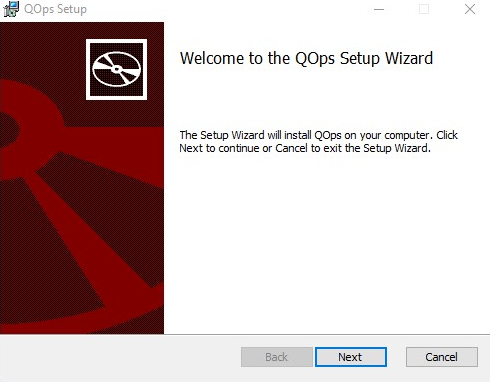
- Accept the licence agreement.
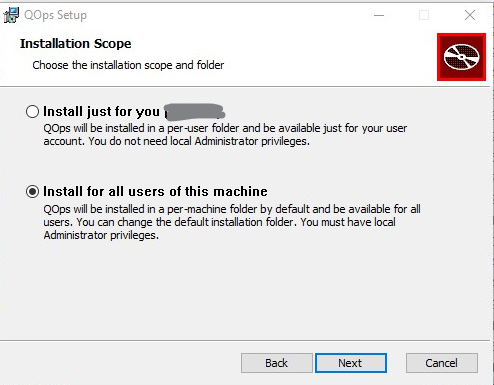
- Choose Install for all users of this machine. Windows asks for administrator rights. To install only for yourself, use
QOpsModule.msiinstead.
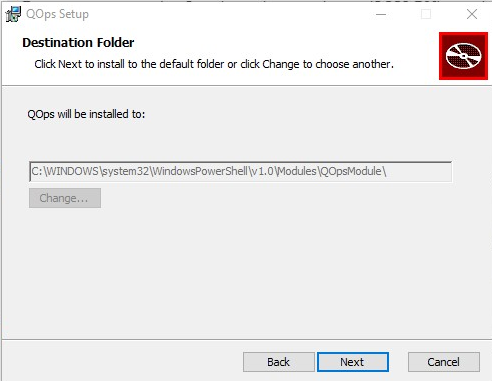
- Check the destination folder. This is the PowerShell 5.1 folder; the PowerShell 7 copy goes to
C:\Program Files\PowerShell\Modules\QOpsModule.
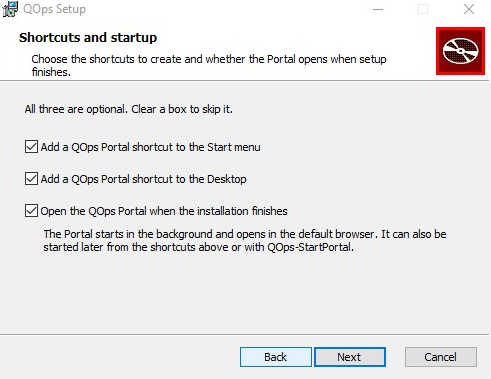
- Choose the Portal options. All three are optional:
- a QOps Portal shortcut in the Start menu,
- a QOps Portal shortcut on the desktop,
- open the Portal when the installation finishes.
- Click Install.
To update later, run QOps-Update or click the version number in the Portal header. You do not need to download the installer again.
macOS (Apple silicon)
Download QOps-macos-arm64.pkg. It installs QOps and the Portal in your home folder, where PowerShell 7 finds them, and needs no administrator password.
The package is not signed with an Apple Developer ID yet, so macOS blocks a double-click on the downloaded file. Remove the download flag, then double-click:
xattr -d com.apple.quarantine QOps-macos-arm64.pkg
Or install from the Terminal:
installer -pkg QOps-macos-arm64.pkg -target CurrentUserHomeDirectory
Both ways install the same thing. You need PowerShell 7.4 or later (brew install powershell).
Linux
You need PowerShell 7.4 or later and Git. Download QOps-linux-x64.zip and unpack it into your PowerShell module folder:
curl -L -o QOps-linux-x64.zip https://github.com/qops-hub/qops/releases/latest/download/QOps-linux-x64.zip
mkdir -p ~/.local/share/powershell/Modules
unzip QOps-linux-x64.zip -d ~/.local/share/powershell/Modules
rm QOps-linux-x64.zip
Then start PowerShell and check the version:
pwsh
Import-Module QOpsModule
QOps-Version
To update later, run QOps-Update.
Next step
Set your licence and connect to Qlik: see First Steps.