Allows setting the multiple QOps parameters in the command line. Parameter values must be set in the
double-quotes.
Alternatively, QOps-Configure may be used to set properties in the dialog mode.
Syntax
QOps-SetConfig [-SenseAuthMode] [-SenseUser] [-SenseCertificate] [-SenseCertificatePassword] [-SenseCertificatePasswordValue] [-SenseURL] [-Prefix] [-JwtToken] [-JwtTokenValue] [-ApiKey] [-ApiKeyValue] [-QOpsProxyOAuthURL] [-Filter] [-TagsFilter] [-TasksFilter] [-CustomPropertiesFilter] [-DataConnectionsFilter] [-ExtensionsFilter] [-Ignore] [-License] [-Mode] [-SkipExtensions] [-Profile] [-GlobalEOLStyle][-AppSubfolders][-UseBuildDiffs][-IncludeBookmarks][-AllBookmarks][-SerializationType][-GlobalSerializationType][-StreamSerialization][-GitHubToken][-GitHubTokenValue][-ClearGitHubToken]
Parameters meaning:
-SenseAuthMode defines authentication mode for establishing the connection to Qlik Sense Server, available values are 'Certificate', 'QopsProxyViaAzureAD' and 'JWT' (since version 1.14)
-SenseUser specifies the User Name for login to the Qlik Sense Server
-SenseCertificate specifies the File Path where the .pfx certificate for Qlik Sense
applications is located
-SenseCertificatePassword requires manual password entering for the .pfx certificate of QlikSense applications
-SenseCertificatePasswordValue specifies the encrypted Password for the .pfx certificate of QlikSense applications. For example: QOps-SetConfig -SenseCertificatePasswordValue (ConvertTo-SecureString "your_password" -AsPlainText -Force)
-SenseURL specifies the URL to Qlik Sense applications
-QOpsProxyOAuthURL defines the URL string with Tenant ID and Client ID specified in the Azure AD SSO mode (see Azure AD SSO Integration for more details).
-Prefix defines a prefix for the JWT Authentication (see JWT Connection for more details)
-JwtToken requires manual JWT token entering (see JWT Connection for more details)
-JwtTokenValue specifies the encrypted JWT token (see JWT Connection for more details). For example: QOps-SetConfig -JwtTokenValue (ConvertTo-SecureString "your_jwt_token" -AsPlainText -Force)
-Filter specifies parameters for selecting applications to process with QOps, allows filtering by the
Application Name, the Application Id, the Application Owner, and the Application Stream; the
multiple masks are supported in a way of repeating the field identifier with a semicolon separator, ex.: -Filter "Name=*ibcs*;Name=*api*,Id=*,Owner=*,Stream=*"
The Semicolon defines result joining with OR logic, the Comma defines results joining with AND
logic. When the field name is omitted all possible values for this field will be applied.
-TagsFilter specifies the tag mask(s) that QOps-PrepareTags and QOps-BuildTags use when they are run without -Filter. Multiple masks are separated by a semicolon. This parameter stores in the local repository settings.
-TasksFilter specifies the reload task mask(s) that QOps-PrepareTasks, QOps-BuildTasks and QOps-TriggerTasks use when they are run without -Filter. Multiple masks are separated by a semicolon. This parameter stores in the local repository settings.
-CustomPropertiesFilter specifies the custom property mask(s) that QOps-PrepareCustomProperties and QOps-BuildCustomProperties use when they are run without -Filter. Without a saved value and without -Filter those commands change nothing. This parameter stores in the local repository settings.
-DataConnectionsFilter specifies the data connection mask(s) that QOps-PrepareDataConnections and QOps-BuildDataConnections use when they are run without -Filter. Without a saved value and without -Filter those commands change nothing. This parameter stores in the local repository settings.
-ExtensionsFilter specifies the extension mask(s) that QOps-PrepareExtensions, QOps-BuildExtensions and QOps-ReleaseExtensions use when they are run without -Filter, and that QOps-ShowExtensions shows by default. Without a saved value and without -Filter the write commands change nothing. This parameter stores in the local repository settings.
-Ignore specifies file mask(s) to ignore them while Git works with the repository, ex.: -Ignore "*.qvw; *.qvd;
*.log"
-License specifies the License Key to be stored in the QOps parameters
-Mode specifies the working mode, available values are QlikSense (default), QlikSaaS (since version 1.15), and QlikView
-SkipExtensions defines that Extensions won't be processed
-Profile defines the User Profile for settings storing and sets it as Profile by default. If -Profile is omitted settings will be stored in the 'default' profile
-GlobalEOLStyle defines the end-of-line style in the global QOps settings. Possible values are CRLF and LF
The line ending of the current repository is the EOLStyle setting in its .qopsconfig, which QOps-Configure asks for. QOps uses the first one that is set: EOLStyle in the repository's .qopsconfig, the global EolStyle set with -GlobalEOLStyle, eol= in .gitattributes, Git's core.autocrlf or core.eol, then the line ending of the operating system.
-AppSubfolders allows to specify the path to an additional subfolder with applications. Multiple paths can be specified using ";" as a delimiter. This parameter stores in the local repository settings. For example: QOps-SetConfig -AppSubfolders ".\subfolder1;.\subfolder2"
-UseBuildDiffs uses differences in the Git repository to build only the changed files. This parameter stores in the local repository settings.
-IncludeBookmarks defines that only unpublished bookmarks should be processed. This parameter stores in the local repository settings.
-AllBookmarks $true makes QOps-Prepare and QOps-Build process all bookmarks of the application, published ones included, as if -AllBookmarks were passed to each run. $false turns it off. This parameter stores in the local repository settings.
-SerializationType sets the format for serialization. Accepts values JSON or YAML.
-GlobalSerializationType sets the default file format, JSON or YAML, for repositories that do not set their own with -SerializationType. It is stored in the global QOps settings and does not convert files in any repository.
-StreamSerialization sets which keys are written for the app's publish target in the app file. Accepts Both (writes both Stream and Space, matches how a repository configured before this release behaves) or Space. Reading is unchanged and has no end date.
-GitHubToken asks for your own GitHub token without showing what you type, and stores it encrypted in the global QOps settings. QOps-Update sends it to the GitHub API, so updates and update checks stay clear of GitHub's shared request limit. The token needs no permissions: a fine-grained token with Public repositories access and every permission at No access, or a classic token with no scopes, is enough. It applies to every repository on this machine and can be set from any folder. In the Portal: Environment settings, Global, GitHub access for updates.
-GitHubTokenValue stores the GitHub token from a SecureString, for scripts. For example: QOps-SetConfig -GitHubTokenValue (Read-Host -AsSecureString "GitHub token"). It cannot be combined with -GitHubToken.
-ClearGitHubToken removes the stored GitHub token, so QOps-Update calls GitHub without one. It cannot be combined with -GitHubToken or -GitHubTokenValue.
Allows setting the multiple QOps parameters in the command line. Parameter values must be set in the
double-quotes.
Alternatively, QOps-Configure may be used to set properties in the dialog mode.
Syntax
QOps-SetConfig [-SenseURL] [-SenseAuthMode] [-ApiKey] [-ApiKeyValue] [-OrgOAuthClientId] [-OrgOAuthClientSecret] [-OrgOAuthClientSecretValue] [-Filter] [-DataConnectionsFilter] [-Ignore] [-License] [-Mode] [-Profile] [-GlobalEOLStyle][-AppSubfolders][-UseBuildDiffs][-IncludeBookmarks][-AllBookmarks][-SerializationType][-GlobalSerializationType][-StreamSerialization][-GitHubToken][-GitHubTokenValue][-ClearGitHubToken]
Parameters meaning:
-SenseURL specifies the URL to Qlik Sense applications
-ApiKey requires manual API key entering to connect to Qlik Cloud
-ApiKeyValue specifies the encrypted Api Key for connection to Qlik Cloud. For example: QOps-SetConfig -ApiKeyValue (ConvertTo-SecureString "your_apikey" -AsPlainText -Force)
-SenseAuthMode QlikCloudOrg authenticates the Qlik Cloud profile with an OAuth client instead of a per-tenant API key; set the client with -OrgOAuthClientId and -OrgOAuthClientSecret or -OrgOAuthClientSecretValue. Create the client under OAuth in the Qlik Cloud management console and give it the trusted consent method; without it the tenant refuses to issue a token. Any client type that issues a secret will do. QOps exchanges the client id and secret for an access token, renews it before it expires, and holds it in memory for the length of the run without writing it to disk. Where a token cannot be issued, QOps reports what the tenant answered. The client sees only what it has been granted access to, so a client with no access to the spaces that hold your applications connects and lists nothing. To return the profile to an API key, run -SenseAuthMode Certificate, the value that means API key on a Qlik Cloud profile.
-OrgOAuthClientId specifies the OAuth client id for the QlikCloudOrg auth mode. It is an identifier and is stored as it is.
-OrgOAuthClientSecret asks for the OAuth client secret without showing what you type, and stores it encrypted.
-OrgOAuthClientSecretValue specifies the OAuth client secret as a SecureString, for scripts, and stores it encrypted. For example: QOps-SetConfig -OrgOAuthClientSecretValue (Read-Host -AsSecureString "client secret"). It cannot be combined with -OrgOAuthClientSecret.
-Filter specifies parameters for selecting applications to process with QOps, allows filtering by the
Application Name, the Application Id, the Application Owner, and the Application Stream; the
multiple masks are supported in a way of repeating the field identifier with a semicolon separator, ex.: -Filter "Name=*ibcs*;Name=*api*,Id=*,Owner=*,Stream=*"
The Semicolon defines result joining with OR logic, the Comma defines results joining with AND
logic. When the field name is omitted all possible values for this field will be applied.
-DataConnectionsFilter specifies the data connection mask(s) that QOps-PrepareDataConnections and QOps-BuildDataConnections use when they are run without -Filter. Without a saved value and without -Filter those commands change nothing. This parameter stores in the local repository settings.
-Ignore specifies file mask(s) to ignore them while Git works with the repository, ex.: -Ignore "*.qvw; *.qvd;
*.log"
-License specifies the License Key to be stored in the QOps parameters
-Mode specifies the working mode, available values are QlikSense (default), QlikSaaS (since version 1.15), and QlikView
-Profile defines the User Profile for settings storing and sets it as Profile by default. If -Profile is omitted settings will be stored in the 'default' profile
-GlobalEOLStyle defines the end-of-line style in the global QOps settings. Possible values are CRLF and LF
The line ending of the current repository is the EOLStyle setting in its .qopsconfig, which QOps-Configure asks for. QOps uses the first one that is set: EOLStyle in the repository's .qopsconfig, the global EolStyle set with -GlobalEOLStyle, eol= in .gitattributes, Git's core.autocrlf or core.eol, then the line ending of the operating system.
-AppSubfolders allows to specify the path to an additional subfolder with applications. Multiple paths can be specified using ";" as a delimiter. This parameter stores in the local repository settings. For example: QOps-SetConfig -AppSubfolders ".\subfolder1;.\subfolder2"
-UseBuildDiffs uses differences in the Git repository to build only the changed files. This parameter stores in the local repository settings.
-IncludeBookmarks defines that only unpublished bookmarks should be processed. This parameter stores in the local repository settings.
-AllBookmarks $true makes QOps-Prepare and QOps-Build process all bookmarks of the application, published ones included, as if -AllBookmarks were passed to each run. $false turns it off. This parameter stores in the local repository settings.
-SerializationType sets the format for serialization. Accepts values JSON or YAML.
-GlobalSerializationType sets the default file format, JSON or YAML, for repositories that do not set their own with -SerializationType. It is stored in the global QOps settings and does not convert files in any repository.
-StreamSerialization sets which keys are written for the app's publish target in the app file. Accepts Both (writes both Stream and Space, matches how a repository configured before this release behaves) or Space. Reading is unchanged and has no end date.
-GitHubToken asks for your own GitHub token without showing what you type, and stores it encrypted in the global QOps settings. QOps-Update sends it to the GitHub API, so updates and update checks stay clear of GitHub's shared request limit. The token needs no permissions: a fine-grained token with Public repositories access and every permission at No access, or a classic token with no scopes, is enough. It applies to every repository on this machine and can be set from any folder. In the Portal: Environment settings, Global, GitHub access for updates.
-GitHubTokenValue stores the GitHub token from a SecureString, for scripts. For example: QOps-SetConfig -GitHubTokenValue (Read-Host -AsSecureString "GitHub token"). It cannot be combined with -GitHubToken.
-ClearGitHubToken removes the stored GitHub token, so QOps-Update calls GitHub without one. It cannot be combined with -GitHubToken or -GitHubTokenValue.
Allows setting the multiple QOps parameters in the command line. Parameter values must be set in the
double-quotes.
Alternatively, QOps-Configure may be used to set properties in the dialog mode.
Syntax
QOps-SetConfig [-Reduce] [-Filter] [-Ignore] [-License] [-Mode] [-Profile] [-GlobalEOLStyle] [-GlobalSerializationType] [-GitHubToken] [-GitHubTokenValue] [-ClearGitHubToken]
Parameters meaning:
-Reduce specifies the mask (masks) of the Application's File Name to apply reduced binary
application storing with properly filed properties set on building the application (QlikView only)
-Filter specifies parameters for selecting applications to process with QOps, allows filtering by the
Application Name; the
multiple masks are supported in a way of repeating the field identifier with a semicolon separator, ex.: -Filter "Name=*ibcs*;Name=*api*"
The Semicolon defines the result joining with OR logic, the Comma defines results joining with AND
logic. When the field name is omitted all possible values for this field will be applied.
-Ignore specifies file mask(s) to ignore them while Git works with the repository, ex.: -Ignore "*.qvw; *.qvd;
*.log"
-License specifies the License Key to be stored in the QOps parameters
-Mode specifies the working mode, available values are QlikSense (default), QlikSaaS, and QlikView
-Profile defines the User Profile for settings storing and sets it as Profile by default. If -Profile is omitted settings will be stored in the 'default' profile
-GlobalEOLStyle defines the end-of-line style in the global QOps settings. Possible values are CRLF and LF
The line ending of the current repository is the EOLStyle setting in its .qopsconfig, which QOps-Configure asks for. QOps uses the first one that is set: EOLStyle in the repository's .qopsconfig, the global EolStyle set with -GlobalEOLStyle, eol= in .gitattributes, Git's core.autocrlf or core.eol, then the line ending of the operating system.
-GlobalSerializationType sets the default file format, JSON or YAML, for repositories that do not set their own with -SerializationType. It is stored in the global QOps settings and does not convert files in any repository.
-GitHubToken asks for your own GitHub token without showing what you type, and stores it encrypted in the global QOps settings. QOps-Update sends it to the GitHub API, so updates and update checks stay clear of GitHub's shared request limit. The token needs no permissions: a fine-grained token with Public repositories access and every permission at No access, or a classic token with no scopes, is enough. It applies to every repository on this machine and can be set from any folder. In the Portal: Environment settings, Global, GitHub access for updates.
-GitHubTokenValue stores the GitHub token from a SecureString, for scripts. For example: QOps-SetConfig -GitHubTokenValue (Read-Host -AsSecureString "GitHub token"). It cannot be combined with -GitHubToken.
-ClearGitHubToken removes the stored GitHub token, so QOps-Update calls GitHub without one. It cannot be combined with -GitHubToken or -GitHubTokenValue.
-VerboseLog enables full verbose output including complete API response dumps and debug information. By default, QOps now produces concise output summaries.
Examples
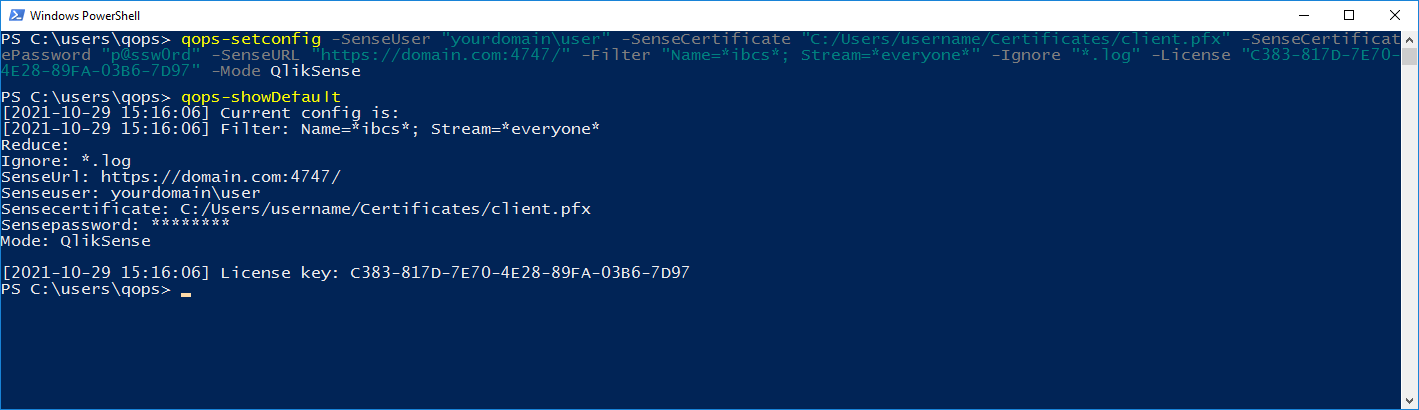
QOps-SetConfig -SenseUser "yourdomain\user"
-SenseCertificate "C:/Users/username/Certificates/client.pfx" -SenseCertificatePassword "p@ssw0rd" -SenseURL
https://domain.com:4747/ -Filter "Name=*ibcs*,Stream=*everyone*" -Ignore "*.log" -License
C383-817D-7E70-4E28-89FA-03B6-7D97 -Mode QlikSense -Profile Certificate
QOps-SetConfig -SenseAuthMode JWT -Prefix jwt -SenseURL https://domain.com -SenseUser domain\username -JwtToken <jwt_token> -Profile JWT
QOps-SetConfig -SenseURL https://domain.com -ApiKey <api_key> -Mode QlikSaaS -Profile Cloud
$secret = Read-Host -AsSecureString "client secret"
QOps-SetConfig -Profile cloud -Mode QlikSaaS -SenseURL https://your-tenant.eu.qlikcloud.com -SenseAuthMode QlikCloudOrg -OrgOAuthClientId <client id> -OrgOAuthClientSecretValue $secret
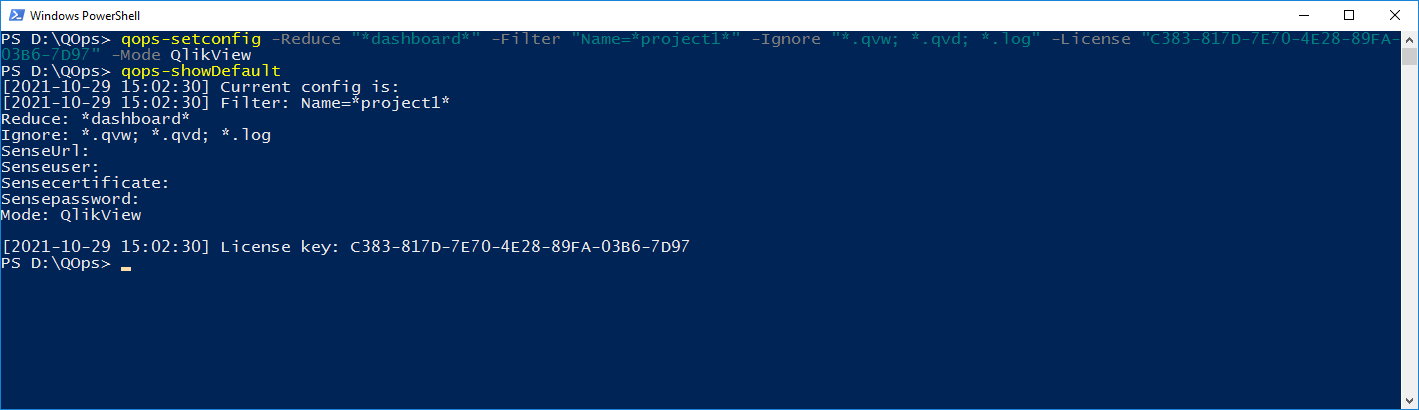
QOps-SetConfig -Reduce "*dashboard*" -Filter
"Name=*project1*" -Ignore "*.qvw; *.qvd; *.log" -License "C383-817D-7E70-4E28-89FA-03B6-7D97" -Mode QlikView
Result in the QlikSense Mode:
Result in the QlikView Mode: